It was a chilly day in February when I found myself perched on an even colder make-shift bench on a pub lined street in Liverpool, my friend’s arms a protective band around my shoulders as I cried.
I’m sure the city is used to having an Evertonian’s tears blotching the pavement, but on this particular day, my emotions were completely unrelated to football.
Moments earlier, we were in a darkened bar, music blaring, occasional squeals piercing the baseline, and flurries of intense flashing lights spotlighting some of the girls’ moves as they danced along to the tunes. It sounds like the epitome of a good time for a group of young women in their twenties, and I wish I could have indulged in some of that joy, but alas, all I could feel was an overwhelming sense of anxiety and vulnerability.
I know it might sound as though I’ve set this up as a ‘poor me’ kind of story, how predictable that the vision impaired person is the one left on the sidelines, right? I would never want my writing to frame a disabled person as the stereotypical helpless bystander to other people’s joy, but I do think it’s important to explore how certain spaces, scenarios, and environments can provoke those feelings.
For me, vulnerability has regularly been tied to the deterioration of my eyesight, but it’s not just this loss that stirs the emotion. More often, it’s the challenge of navigating such a visual world as someone who was never truly considered in its design.
Living as a disabled person has made me into something of an expert at swallowing certain emotions, all in the name of trying to fit in, or, god forbid, avoiding being seen as a burden (hello, internalised ableism). But if blogging for the past ten-plus years has taught me anything, it’s that sharing these personal thoughts, feelings, and experiences isn’t just a way to loosen the tightening thread in my own mind, it’s also a way to extend a reassuring hand to others who might be feeling the same. I’ve learned there is always at least one.
Vulnerability is a word that carries a lot of weight, but what does it really look like when you’re the one living it? Let’s dig into that..
Whilst the feeling has been tucked away in corners of my mind in the past, it’s not something I’ve truly reckoned with and unpicked until this year.
I found myself in a similar state to the one I described earlier just a few weeks before our Liverpool escapades. This time, I was on the precipice of an exciting opportunity which would see me heading to Cardiff to host a panel discussion with the stars of a new theatre production. It would be the first time I was travelling there without the familiar faces of my work colleagues to meet me at the other end.
The more I mused about the journey, the more overwhelmed I felt, and I found myself momentarily abandoning my packing efforts in order to do what only feels natural in such a state – sit on my bedroom floor with my knees drawn up to cradle my head.
At the core of my anxiety wasn’t the fear that I wouldn’t manage the trip on my own, but rather the worry that I hadn’t prepared enough if something were to go wrong. You see, navigating these situations without conducting PhD-worthy levels of research beforehand feels impossible, and the mental exhaustion is real before even taking a step out the door. Plan B, C, and D have to be in place, just in case things go awry, each one laid down like stones in my mind, smoothed by my ‘everything will be okay’ mantra.
Vulnerability, for me, is often synonymous with relying on services that are, at best, unreliable. For this particular trip, my mind whirled as I wondered what I would do if the train assistance didn’t show. How would I navigate the station? Would I be able to find the taxi rank? These were the questions I couldn’t shake as I mentally mapped out the journey, anticipating every possible hiccup. This was before I discovered that the hotel I was booked into was on a pedestrianised street, and I found myself wondering how I’d find my way there.
It takes practical, daily negotiation with the world around me to answer these questions with solutions I’m in control of if the systems fails to turn up.
When my pre-booked assistance was a few minutes late in arriving, I asked a fellow passenger to help me step onto the platform (handling a cane and a suitcase is a challenge like no other), and when we reached the edge of the hotel’s street, I trusted the taxi driver’s offer to guide me to the door, knowing I had my maps app on hand and my family’s nervous faces just a FaceTime call away if I hadn’t received that support.
When I arrived, a hotel receptionist kindly guided me to my room, and whilst I took up that offer of a video call with my Mum to find my way back to the entrance that evening, I was soon able to trace the route myself when I’d walked it enough times.
Once I had established my confidence, it felt a little easier to confront the world’s visualness, and it was freeing to carry that belief with me as I made my way to a lunch catch up with a work colleague on my first full day in the city.
The fabulous team who were behind my trip went above and beyond to ensure that the rest of my time was spent sans any worries, and when the assistance guided me to my seat on the train back home, I realised how quickly feelings of anxiety and vulnerability dissipate when people see you, hear your asks, and turn up.
But as we set off from the station, the unnerving feeling settled over me once again when I realised the journey was devoid of announcements. Phone signal on the line back up north is dodgy at best, so I knew that pinpointing my whereabouts with my maps app would be too fickle an option. The only alternative? Search how many stops there were from one of the main stations closer to home which I knew we’d pause at for a little longer than others, and tick them off one-by-one, letting my memory form my map.
It can be disorientating, moving forward but not being fully certain where you are on that journey. Navigating the world as a disabled person often feels like being suspended in some kind of limbo, forever waiting for accessibility and inclusion.
I plugged one of my earphones in as we sped along the tracks, letting the music distract one half of my mind whilst the cord of the other earbud dangled as a tie to the outside world, leaving that side of my hearing alert to any clues as to where we might be.
The world feels a little less safe when accessibility isn’t considered, spinning on an axis that’s more uncertain. I feel it in moments where announcements are absent, when the pre-booked assistance is another ghost in the system, when I have to speak my personal information aloud in public in order to make a payment because the card machine is touchscreen, or when cars park on pavements, forcing me to walk out into the road in order to get past.
Stereotypes label me as the vulnerable one, while ableism casts my vision impairment as something to be pitied.
I won’t gloss over the fact that I do feel more vulnerable or unsafe in certain situations due to the fact that I can’t see what’s happening around me. It becomes tricky to navigate spaces when music swallows the chatter of those nearby, when a crowd is so vast that the voices blend into a single murmur, or when construction work or wind drowns out the sound of everything else. It’s easy to feel untethered in moments like these, when the hubbub of the world dislodges the anchor on your other senses, leaving any feeling of belonging adrift.
A sense of vulnerability flares in these moments, when the weight of not knowing who or what is near sharpens into something tangible. But let me be clear: for the most part, this feeling is not a product of my vision impairment. No, it breathes in the world’s refusal to see the essential need for access and inclusion.
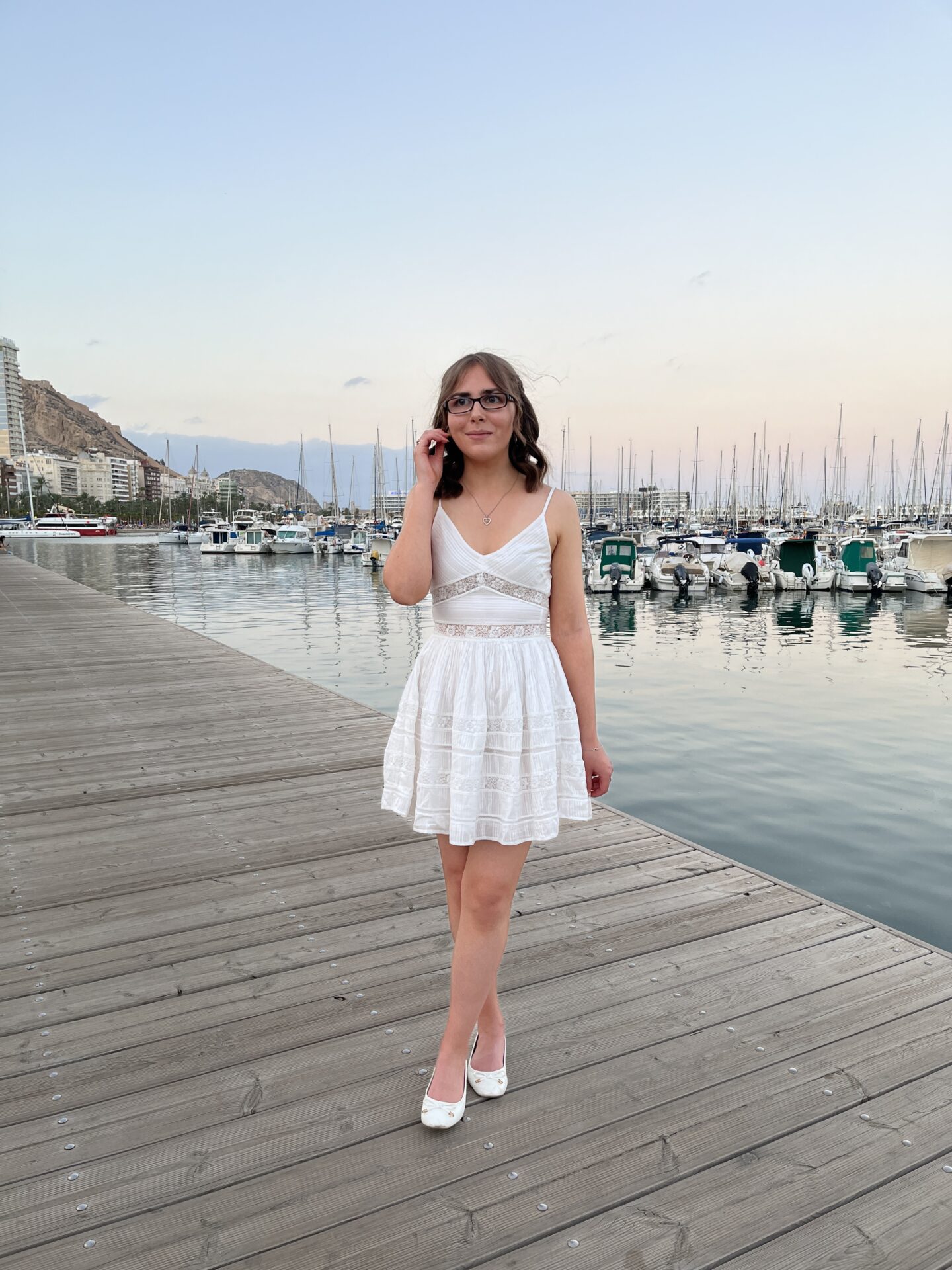
When the world speaks about disability, it all too often frames disabled people as a ‘vulnerable’ group, and fails to recognise how vulnerability breeds in the gaps of its own narrow design.
Society often puts us in situations that leave us guessing. It demands that we fight for our basic rights, yet smothers our voices beneath the sound of its own priorities. We’re abandoned on trains or platforms by a system that breaks its promise. We’re faced with accusations of ‘faking’ if we don’t satisfy people’s stereotypes, we’re told that ‘it’s all in our heads’, left fearful of further cuts to support, forced to navigate misunderstanding, and find ourselves fending off ableism day-after-day.
In these moments, I don’t feel weak, I feel ignored.
I know I’m not the only one who’s felt this. We all have these moments where the world feels bigger, more overwhelming, more distant because the space we occupy wasn’t designed for us. It’s not my vision impairment that creates these feelings — it’s the pockets of society that don’t consider my rights or desire to be present.
The tears I shed in Liverpool weren’t the consequence of sadness, but rather the weight of too much.
We live in such a visual world and navigating it when accessibility isn’t up to scratch in all aspects is difficult. I had been feeling overwhelmed by the barriers, the research, constantly demanding change, and the exhaustion of it all for a while. Add in the feeling of isolation that manifested in an inaccessible environment, and that was enough for the emotions to come pouring out. Not that they needed to be justified.
If the world were built differently, if these places were designed with disabled people in mind, would I still feel so vulnerable? Would I still need to summon so much courage and strength to navigate the world? I’m going to bet on ’no’.
The truth is, these moments of vulnerability wouldn’t feel so heavy if the world simply adjusted to be more inclusive. If the systems took our needs into account, if people understood the importance of awareness, action, and simple changes.
No one deserves to feel unsafe or vulnerable when stepping out into the world. I wanted to bring some of my thoughts and experiences here to reassure any other vision impaired people who might have felt the same. We’re a resilient bunch and none of this is on us.
The more we speak about these moments, the louder the demand for change becomes. We deserve to live in a world that considers us, not as an afterthought, but as part of the conversation. The more that happens, the closer we get to a world where these feelings of vulnerability can dissipate and no one feels like they have to cry on a street corner, lost in the overwhelming silence of a world that forgot them.
Is this feeling something you can relate to? I know how isolating emotions and experiences like this can be, so my hope here is that hearing my truth will ease some of that tension for someone else. The real vulnerability lies in how society tries to convince us that we are fragile, unequal, or unworthy, and then expects us to adjust to a world that was never built with us in mind.
We deserve better, and I do believe that change will come. It starts with awareness, with listening, and asking how to create spaces where everyone feels seen, heard, and valued.
I know there’s still a long way to go until that happens, so if you too need a shoulder to cry on when things get a little too much, you know where I am.
Elin x
Share this:

Discover more from My Blurred World
Subscribe to get the latest posts sent to your email.
You May Also Like

The Comments
Lrock
I always appreciate your down to earth accounts of living with vision loss. Thanks for sharing your thoughts and experiences.
Elin
LrockThat’s really kind of you to say, thank you!
Patsy
So moving Elin! How right you are. The fault is all in the world, with failing to adapt to the diverse needs of people. Carry on the good fight, hoping equality will one day be for everyone.
Elin
PatsyThank you, Patsy! I really hope so.
lynnenicholson
I’ve recently written a similar blogpost after a bus journey to a hospital appointment where Voice Vista failed when the mobile signal failed. By the time I got home I felt like a 6 year old child who’d fallen apart after she’d been found after being lost on a family outing. Not a pleasant experience for a 64 year old who had been confidence after becoming blind 9 years earlier.
Sending love and strength your way Elin.
Elin
lynnenicholsonThese experiences are so disorientating and exhausting aren’t they Lynne. Sending love and solidarity right back. Thank you for reading.