If there’s one thing in my life that I find myself talking about time and time again, it’s my vision impairment. There are a grand total of 32 archive pages (and counting) on this blog to back me up here, all of which are brimming with carefully curated features on my experiences of facing prejudice and misconceptions, finding independence and confronting spells of loneliness and isolation due to living with sight loss.
Amongst them, you’ll find posts on confidence and music and, if you look closely, you’ll stumble upon the occasional reference to my chronic illness, ME/Chronic Fatigue Syndrome.
But these references are in short supply, on and offline I’ve realised.
So, I started to pick through my thoughts on this, mulling over the idea that I’ve quite possibly been hiding my chronic illness behind my vision impairment, mostly unconsciously, but welcoming the smokescreen at other times.
These thoughts have sparked ideas that I haven’t necessarily entertained before, warranting some blogging inspiration in the process and so, I thought it’s only right that I see them through.
We’ve established that I’m quite an open book when it comes to my vision impairment; I’ll always happily witter on about the experiences I’ve had, good and bad. Whilst there are times when I’d like to stray away from the topic, you’ll often find me entertaining people’s curiosities and attempting to portray an alternative depiction to the stereotypical image of vision impaired people.
But whilst I’m doing so, my body is being attacked by Myalgic Encephalomyelitis (ME) / Chronic Fatigue Syndrome (CFS). A condition that dictates my life in a way my vision impairment never has.
It assaults the choices I make; Dictating how many tasks I can tick off my to-do list; Influencing my plans and deems planning and striking a balance as essential parts of my life.
And yet, no one would know this since I don’t talk about it and, when I do, I might only be making casual references that are often disregarded.
I’m fully committed to the idea that a person should share as much or as little as they wish when it comes to their personal health. My decision to share my sight loss story wasn’t made lightly but I’m so glad I made that choice. However, delving deeper into the minutiae of my chronic illness is still a work in progress, on and offline, like I said. But there are strands of it that I’d like to explore further, hence why I’m here writing this today.
This topic has been playing on my mind for a while and since May is ME Awareness month, I feel as though it’s fitting that I finally bite the bullet and venture to tap out my thoughts on this, hoping that some kind of coherence can be found in what I’m about to type.
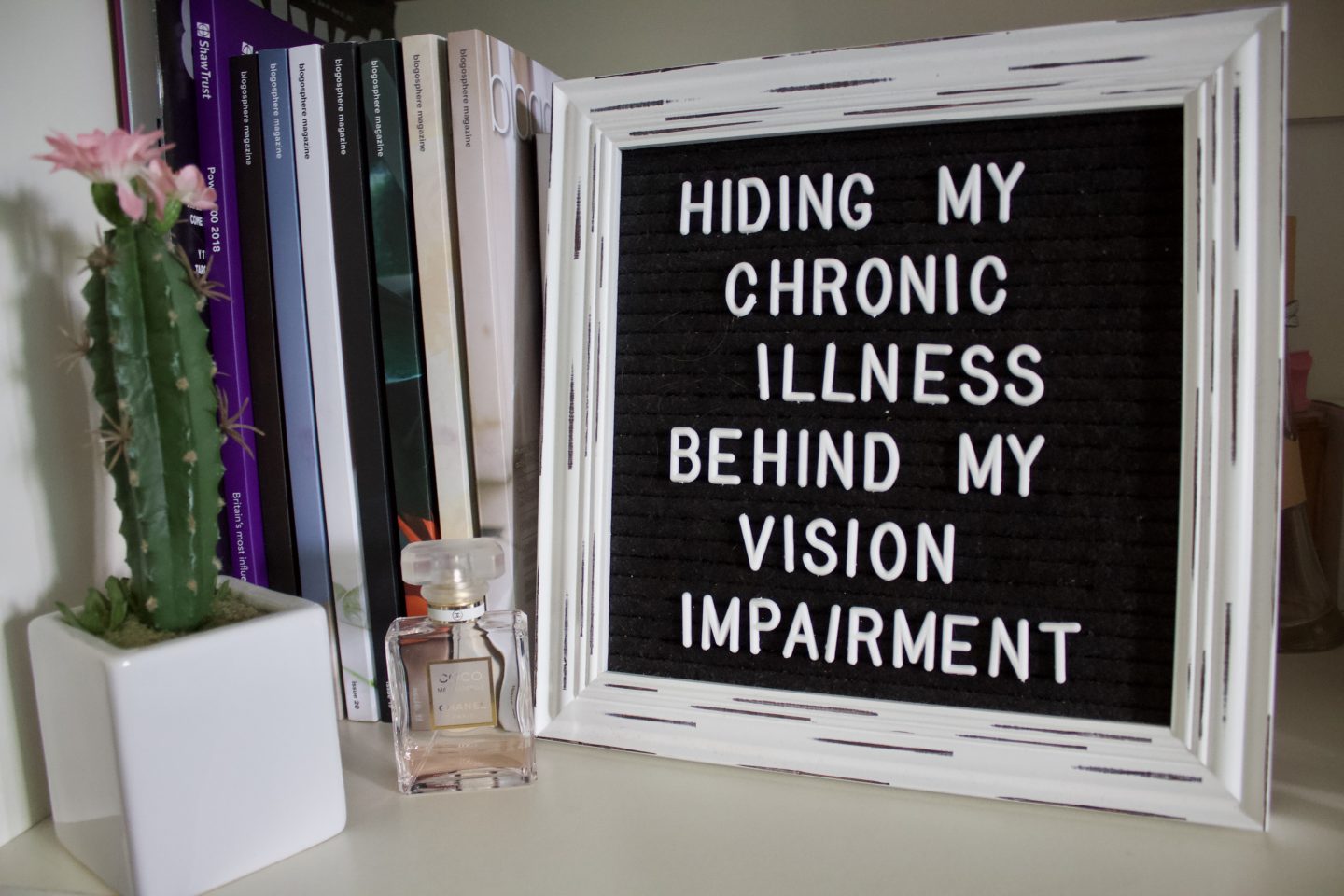
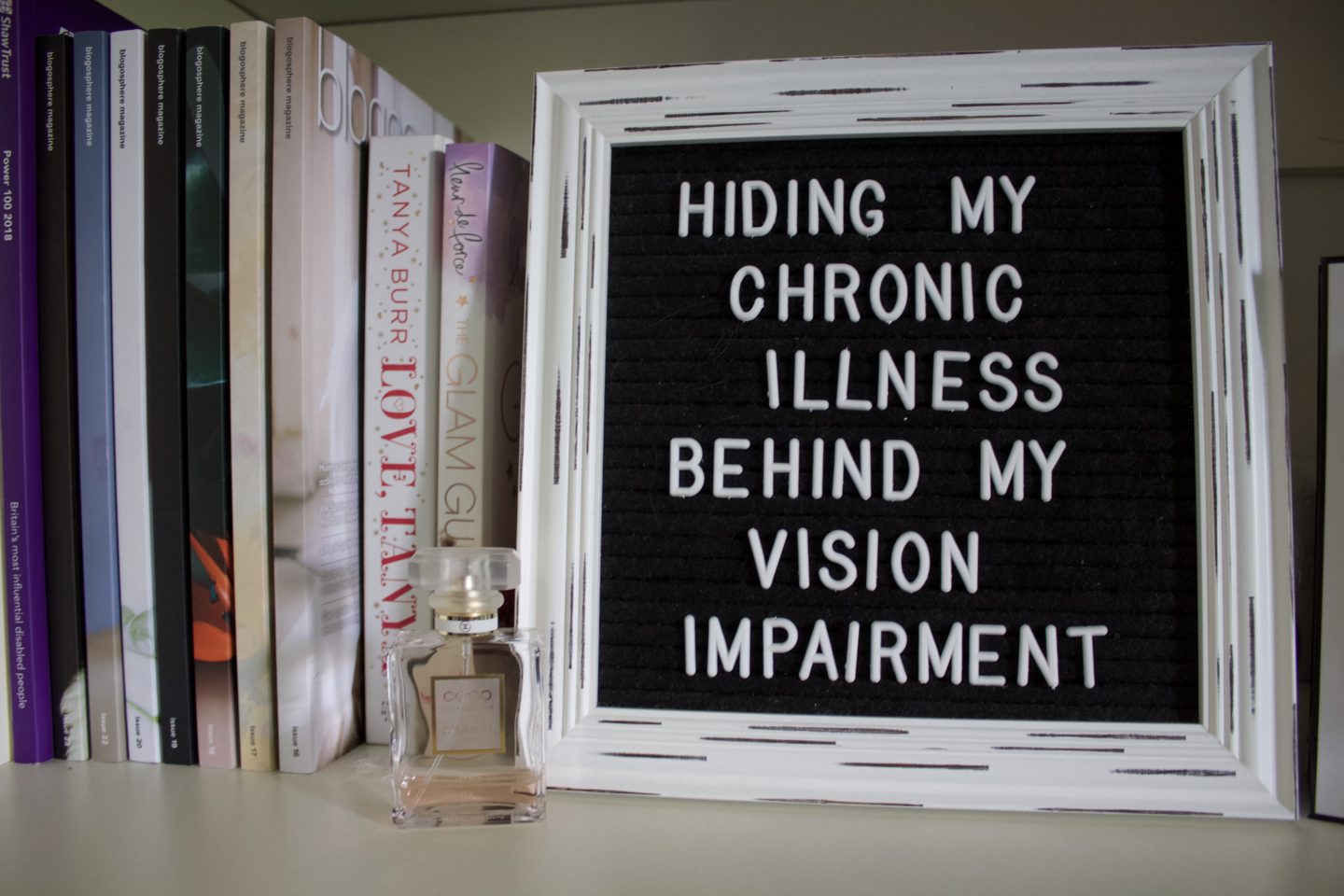
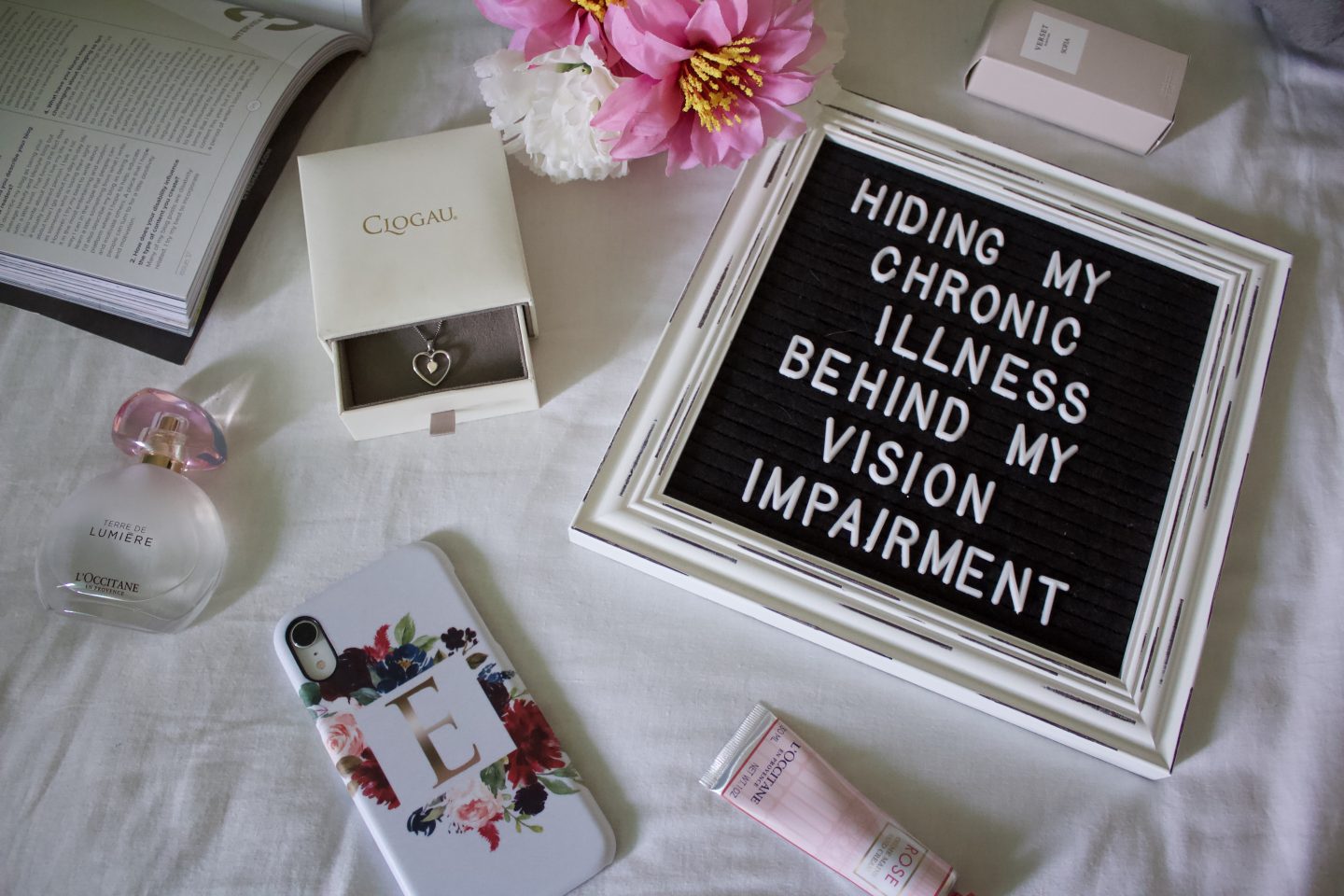
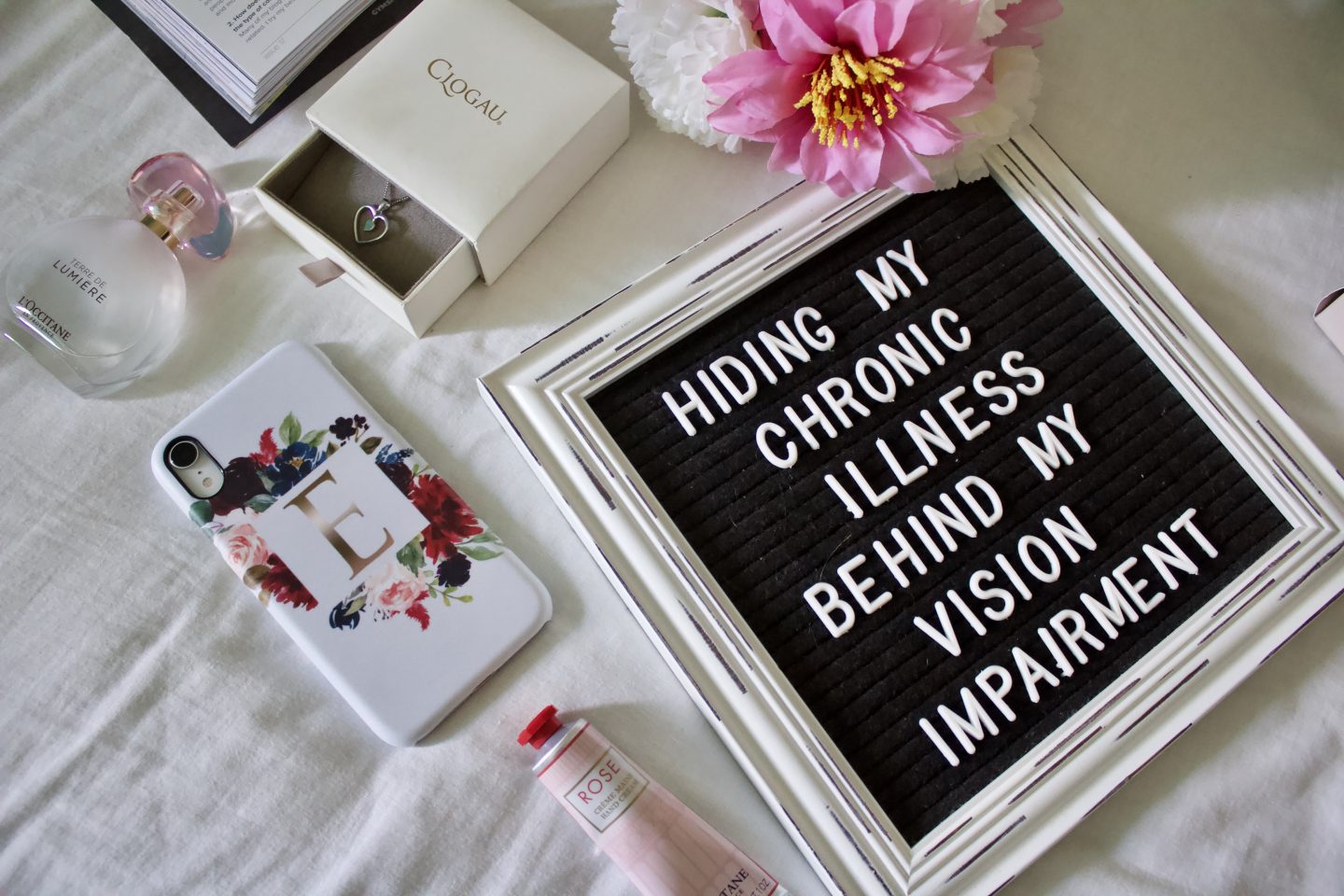
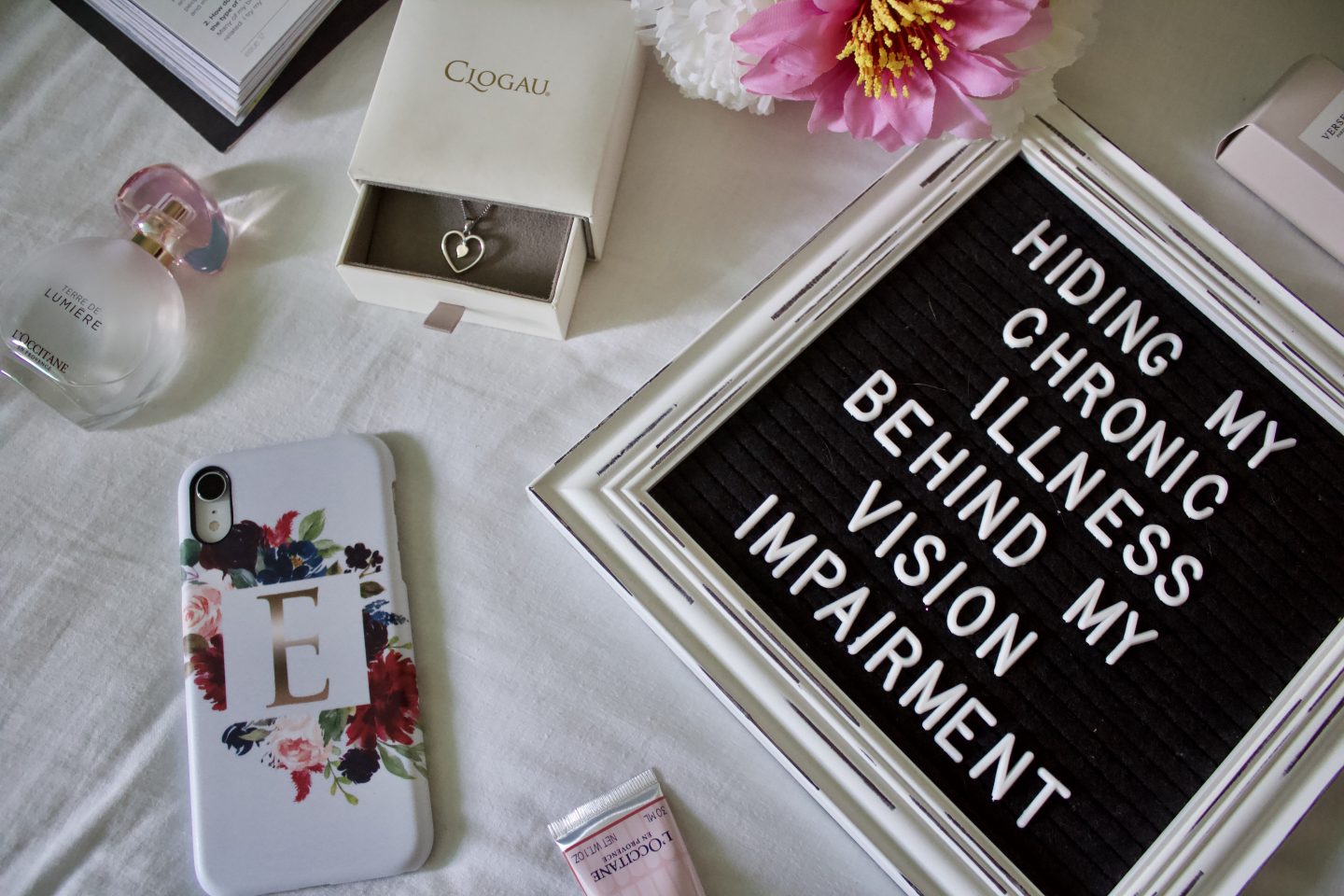
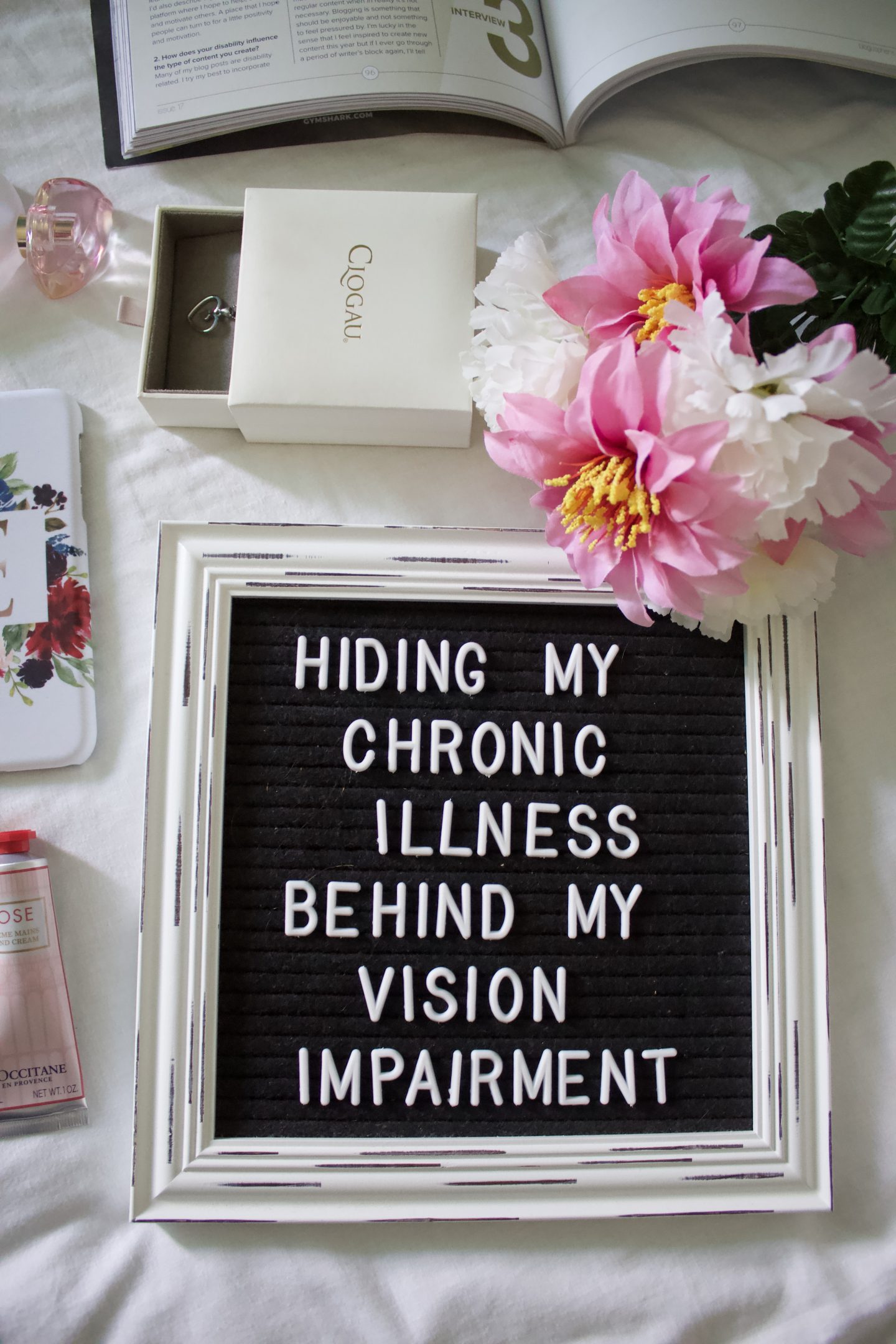
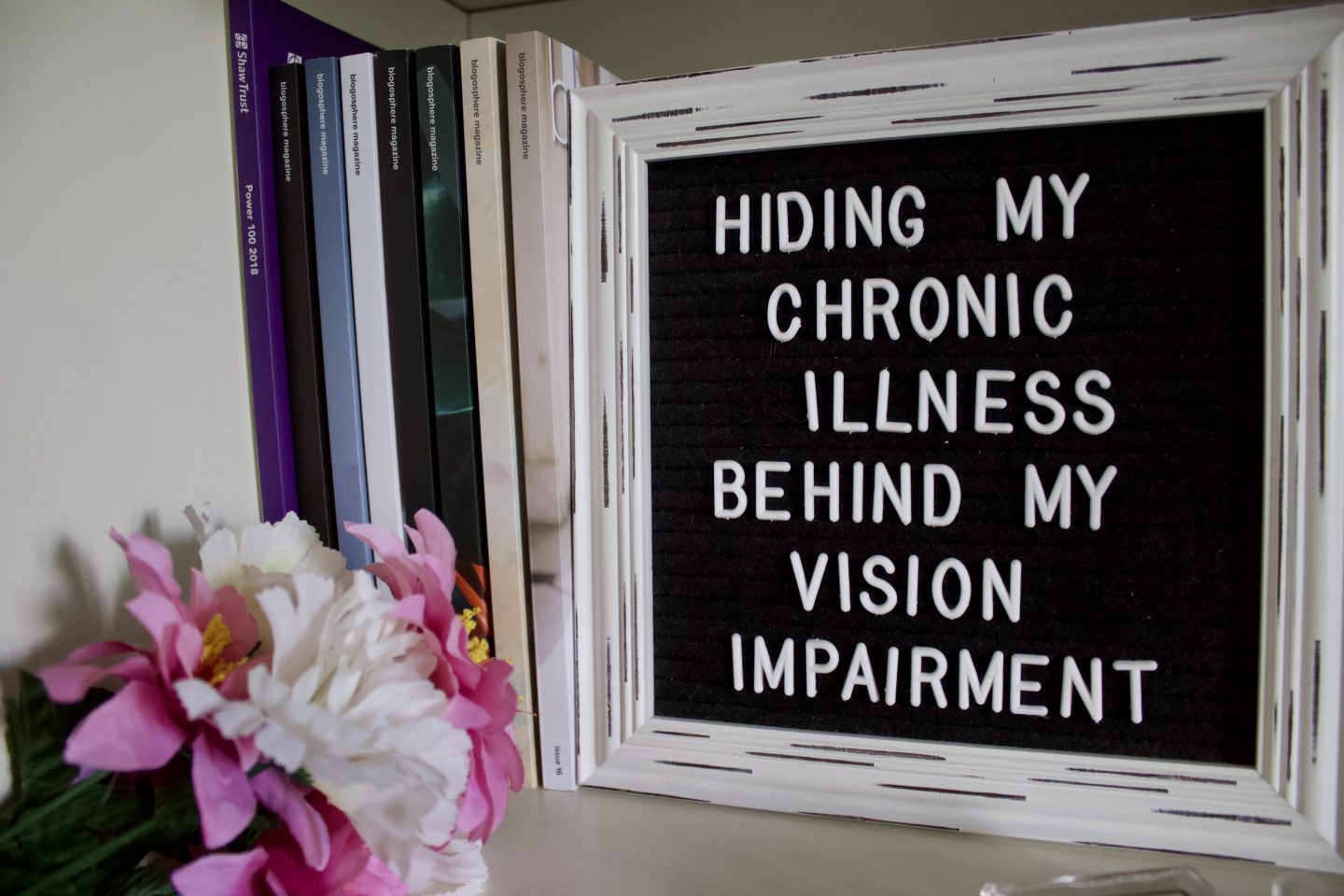
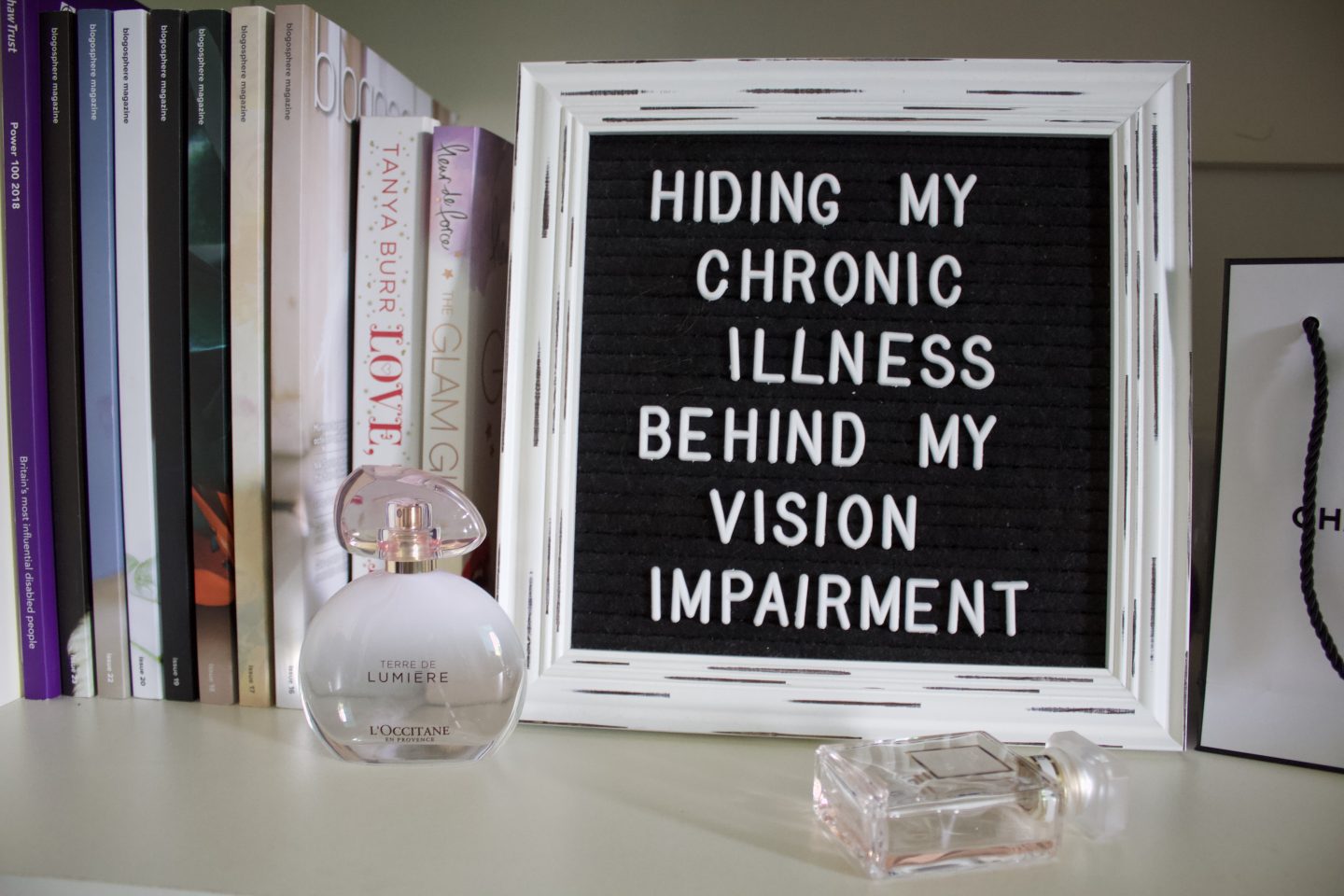
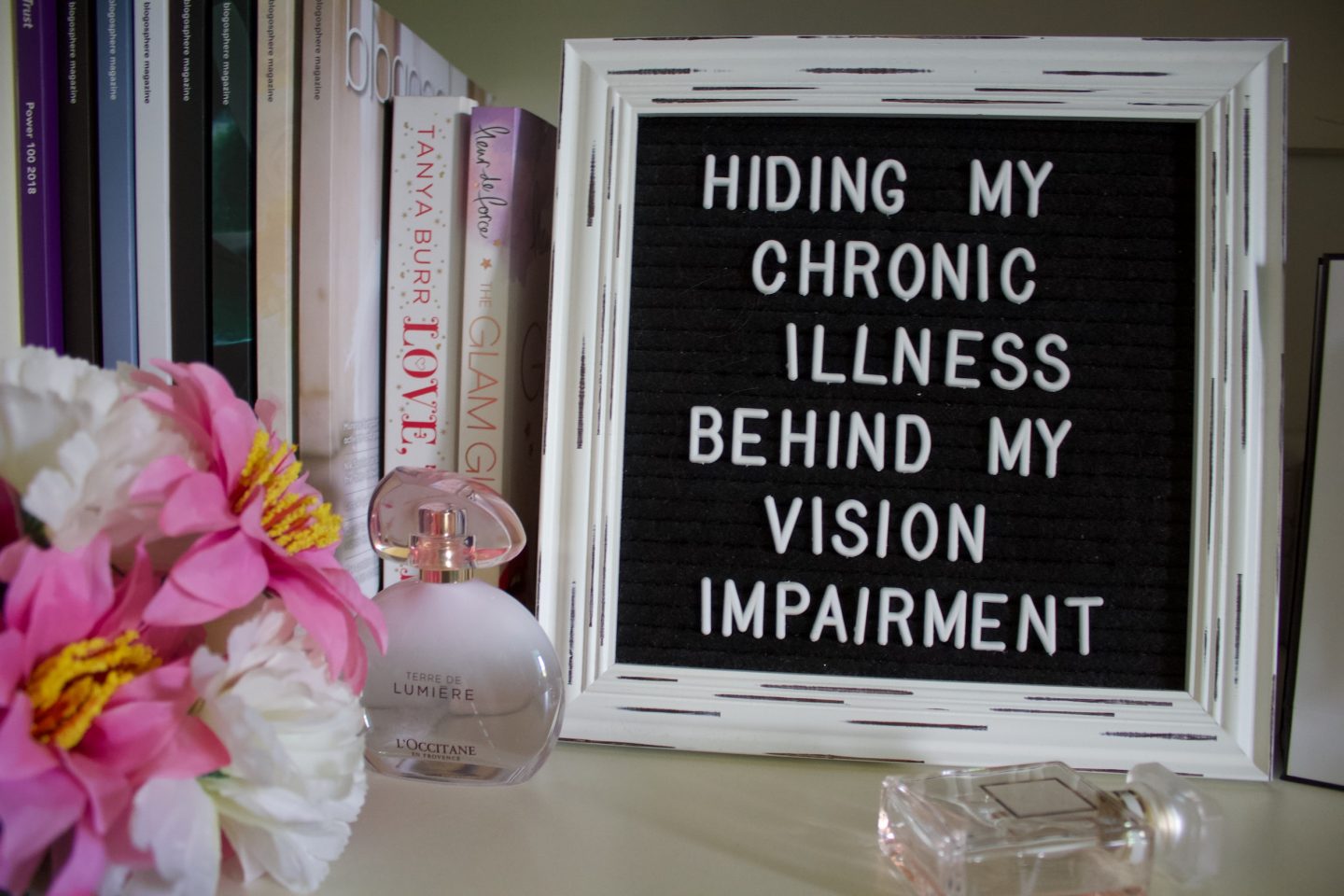
HIDING MY CHRONIC ILLNESS BEHIND MY VISION IMPAIRMENT
I’ve skirted the boundaries of sharing my chronic illness story through one or two blog posts on here in the past along with a couple of guest articles for Scope and Astriid. Offline, my immediate family have witnessed my symptoms at their worst and I’ve sent the odd message to my friends to restructure or cancel plans, explaining that my energy levels weren’t granting me the luxury of seeing them through.
But that’s as far-reaching as my chronic illness sharing has extended.
When I compare that to the 200+ blog posts I’ve written, solely focusing on sight loss, not to mention the guest articles and interviews I’ve done along with innumerable questions I’ve answered with regards to my vision impairment, it’s clear to me that I’ve let my deteriorating eye condition snatch the spotlight. What a diva.
Because of this, my chronic illness has been sitting in the wings, unseen by the audience.
Whilst my vision impairment decreases in its obviousness when you take my cane out of the equation, it’s very much a noteworthy aspect of my life since it’s grown to be something I find relatively easy to expose through a simple ‘I’m vision impaired, can you give me a hand with this, please?’ request. While ME/CFS perches on the other end of the spectrum. And because of its invisible attributes, it has been easier to conceal ME’s impacts on my life.
I touched on this concept of how my disabilities sit on both ends of the visibility and invisibility spectrum in a guest blog post for Scope last year. I think that this spectrum has been the baseline for the level of sharing I choose to indulge in.
Conversations naturally sway in the direction of my vision impairment, whether that’s because of the fact that I’m using my cane, being sighted guided or the fact that I choose to be open about it in order to ease the difficulty of a situation.
People’s curiosities often perk after they realise that I’m VI and after being met with question after question with regards to my eye condition, introducing ME into the conversation seems too exhausting a prospect. No pun intended.
And if I’m completely honest, talking about my chronic illness feels like vulnerable territory for me, just as the subject of sight loss was when I was first identifying the best ways of opening up about my struggles.
It’s frightening, to expose an aspect of your life that has taken so much away from you. It’s frightening because there are so many misconceptions out there and you simply don’t know how people are going to react.
I was diagnosed with ME/CFS almost six years ago but my life was plagued with symptoms for years before then. It became a debilitating force in my life and yet no one, apart from my immediate family, ever witnessed its true impacts.
I was constantly wishing to be understood, willing people to recognise my weakest moments. And yet, a part of me was still struggling to articulate my symptoms. I didn’t know how to word the fact that brain fog occupied my mind in more of a dramatic way than usual, encouraging lack of concentration and sweeping up motivation and inspiration in its tracks; The times when my fingers fell limp on my keyboard because my illness stole the last fraction of energy from my body; I didn’t know how to explain the unintelligible mumbles that fell from my lips when my brain didn’t afford me the opportunity to string coherent sentences together anymore.
And a lot of this still stands.
A part of me is wary of committing to sharing this narrative of my illness because it has so often been disregarded in the past. So often glossed over, branded as ‘stress’ or ‘just tiredness.’
Whilst my diagnosis armed me with some relief in knowing what was wrong, I guess I was still wary of venturing down the avenue of explaining my condition because I was still skeptical of the fact that people wouldn’t believe me.
And I guess I still carry some of that fear.
ME is a condition that’s so often misunderstood, and most still struggle to fathom the fact that it’s more than ‘just tiredness’.
My symptoms started to manifest during my time at school; I missed over half of my first year of sixth form because of it and suffered the consequences of that when it came to my exam results that year. But my absence wasn’t often met with sympathy.
My vision impairment was better understood in many ways because steps could be taken to ease the difficulty of some situations. Forming accessible alternatives was easily comprehensible; My work could be adapted into an accessible format; I could be guided from one class to another; I could complete my work on a laptop; I had support.
But none of this was applicable to my chronic illness and when I tried my hand at talking through my symptoms, it felt as though my words were landing on concrete ground. They weren’t cushioned with understanding or sympathy.
I was investing the limited supply of energy I had into trying to convey how I felt, only to be made to feel as though my experiences were redundant and insignificant.
I guess I became frozen in the mindset that no one would ever understand because of this, and it meant that I harboured some reluctance in addressing my chronic illness, out of fear that my experiences would be waved away by unhelpful solutions, just as they had done for years.
‘Have an early night.’
’Take a nap.’
’Take it easy.’
These were the only responses people offered when I shared my struggles and, no matter how much emphasis I put on the fact that no amount of sleep could take the exhaustion, the pain, the brain fog or the light headedness away, my voice still wasn’t being heard.
I had faced the repercussions of sharing aspects of my sight loss journey, some of which were exhausting to endure. In a way, knowing what results could be derived from sharing such a vulnerable aspect of life only magnified my wariness to divulge more.
It felt as though people believed that my CFS symptoms could never match the impacts sight loss was having on my life, and it meant that I grew tired of explaining.
So, I guess you could say that I started to suffer in silence since it seemed that my eye condition would always take centre stage. My chronic illness was cast aside, pushed to the shadows and it meant that I was scared to bring it back out again.
Hiding it became the less painful, and the less complicated option.
I guess you could say that my chronic illness was (and still remains to be) the elephant in the room. It’s rarely abating in its existence but I haven’t felt fully ready to press the play button and showcase every facet of its impact.
Whilst I’ve been living with ME/CFS for the best part of a decade, it still feels very new to me and I think I’ve fallen into the same predicament as I did when initially attempting to depict the impacts of sight loss.
So, I’ll happily say that I feel a little like a bird who hasn’t quite learned how to fly; I just haven’t grasped the art of defining and sharing my illness in a way that truly honours the impacts it has on my life. And, because of that, I welcome the smokescreen my vision impairment can provide at times.
I, of course, believe that it’s incredibly important to raise awareness of both conditions, one doesn’t deserve to be regarded any higher than the other. But I also think it’s important to recognise the fact that opening up about your health, even to those closest to you, isn’t always the easiest thing to do.
It took years for me to speak openly about my sight loss journey. It was a case of finding acceptance and taking baby steps into the conversation, something I’m still trying to do when it comes to ME/CFS. And that’s ok.
Whilst I’ve developed a good understanding of how much I’m comfortable in sharing about my disability due to doing just that with my vision impairment, combing through the impacts of a condition that impacts my life in such a contrasting way to sight loss is tricky.
I’ve reached the comfortable stage of talking about my vision impairment after YEARS of practice, but the fact that the onset of my chronic illness occurred in my teenage years means that I still find some aspects of it to be quite raw.
Although I wouldn’t recoil when someone asks about my chronic illness, my depiction of the condition could never be as vivid as it would be for my vision impairment. It feels slightly more stunted and unnatural. A work in progress, if you will.
I guess I could also say that my reluctance to talk about my chronic illness is accredited by the fact that I’m scared to break away from the conversational grounds I’ve already rooted down in. But I am slowly drifting down different avenues of sharing and, no matter how much that is, I think it’s important to acknowledge any level of progression.
It’s safe to say that I have become accustomed with the wave of conversation that comes with disclosing my vision impairment, and I guess I’ve been scared that the current of the misconceptions and questions that would meet my chronic illness revelation would wash me away.
I’ve allowed myself to be coddled in the slightly more comfortable territory of narrating my sight loss story because of this, expertly squashing my feelings and thoughts regarding CFS deep down within.
I think we all experience that gnawing feeling in the pit of our stomach when moulding the clay of our identity and articulating that to someone else, since it’s such a candid process.
I think it takes a lot of bravery and courage to be open and honest about how you feel. If you’re in a place where you feel comfortable in talking about your experience, I admire your honesty and commitment. But if you’re at a similar stage to me in terms of ME/CFS and you’re simply taking baby steps and being honest with yourself about your feelings and limitations, you should know that’s enough too.
My chronic illness is slowly leaning further into the conversation, peeking out from its hiding place ever so slightly, simply allowing me to find the right balance between sight loss and CFS, a task that should come naturally to me since finding balance has been something of a second nature to me for years.
Whilst my public references to my own experiences of living with ME/CFS are limited, awareness for the condition is still a very close matter to my heart. ME/CFS affects over 250,000 people in the UK alone and that figure isn’t one to be ignored. I can imagine that I’m not the only one in that number who struggles to articulate my lived in experiences of this debilitating condition.
So, I’m curious to know if you can relate to any of what I’ve talked through today; Can you share some of the emotions I’ve captured here and possibly position them as recognisable moments or feelings in your own life too?
I think I’ve hidden my chronic illness behind my vision impairment because, 1) I haven’t been brave enough to tell people how I feel. 2) I’ve feared the weight of the misconceptions that could come hand-in-hand with this revelation and 3) I think I’ve subconsciously known that straying away from the topic was granting me the opportunity to decompress everything it means for me in my own mind, and I think that’s an incredibly valuable step in this journey.
I know I have a long way to go yet before I reach a point of achieving complete honesty about how ME/CFS is affecting my life and, as I edge closer to that point, I’m telling myself that I need to stumble in conversations instead of hiding away.
I know that my vision impairment will always take centre stage when it comes to how open I am about my disabilities because I have to embrace what I’m comfortable with. But I do believe that progress can be made in terms of how open I am about ME/CFS.
So here’s to nudging Retinitis Pigmentosa to the right slightly and learning to share that spotlight.
Elin x
Share this:

Discover more from My Blurred World
Subscribe to get the latest posts sent to your email.
You May Also Like

The Comments
SJG
Hi Elin.
Can totally relate to this. Not only do I have RP. I also have a couple of other conditions that flare up and take that centre stage whether I like it or not. I tend to remain quiet as many folk dont understand and at times, have avoided certain topics or me, as a result, which I never wanted.
Sometimes I just want to share what’s happening with me with someone close,like a friend. I dont expect to be fixed or for them to have all the answers. Its just nice to talk, be heard and supported.
We have the disease. The disease does not have us.
Would love the chance to chat all things RP and everything else in-between.
Keep sharing. Much love
Elin
SJGI think you’ve hit the nail on the head there, sometimes just having someone there to listen is the most valuable thing. To be heard and supported takes so much weight off your own shoulders doesn’t it. If you ever want to talk through anything then please feel free to get in touch with me, I’m always at the other end of an e-mail. Thank you so much for reading as always.
mark kent
very very well done for talking about m.e . I HAVE THIS plus long list health issues ..ibs.migraines .list goes on.i take part in a lot lot research /people never see the every day effects .there views/judgements are very Snotty Nosed
my blog,http;//mark-kent.webs.com
twitter,supersnopper
Elin
mark kentThank you so much for reading, Mark.
Laura Beth
Hi Elin, thank you for sharing! There are many more people that I know, with time and effort, that have opened up and shared their stories and struggles of chronic illnesses. I’ve seen CFS come up a lot more frequently in the last few years, as well as Complex Regional Pain Syndrome (CRPS). I’ve tried to do as much research on my own, as I can’t truly empathize with anyone since I don’t have CFS or CRPS. The other big one is lupus. I thought I understood it – Boy, was I wrong. It truly affects each person differently. There will always be people who are dismissive and ignorant, unfortunately. I’ve been there, done that, with my Generalized Anxiety Disorder diagnosis. Having people actually listen to you and wanting to learn more is huge! Hugs to you.
Elin
Laura BethHi Laura, I completely agree with you – although someone might be living with the same condition, symptoms and their severity can vary so much, that’s why I think it’s so important to talk openly about it and raise awareness. I’ve definitely learned so much about my own conditions from reading other people stories, they can be so eye-opening! Thank you so much for reading as always, sending hugs right back at you!
Holly
So so proud of you for opening up and talking about this, it’s atopic that I’m sure many people can relate to in one way or another. Huge well done! xxx
Elin
HollyThank you so much honey, I really appreciate this xxx
navigatingblindness
Thank you for this post. I can relate. My son’s sight loss has taken front and center in my thoughts and writing for the last 7 years, and like you I occasionally mention my multiple health issues (multiple autoimmune diseases). Ive been sitting with the awareness of this & exploring it as well. I did do an article for Capitvating magazine about my own disability and felt very vulnerable (but strong) about it. I even shared it with my doctor! If you’d like a link to it please let me know. I look forward to listening to all you have to share.
Elin
navigatingblindnessI can completely relate to that vulnerable feeling but also the sense of strength that can be drawn from opening up too. Your article sounds really interesting, I’d love to have a read at some point. Thank you so much for reading.
Anika
Brilliantly written post, I love how open and warm your writing is while still being very matter-of-fact. I don’t know much about ME/CFS but it was really interesting reading this from your perspective xx
Anika | chaptersofmay.com
Elin
AnikaThank you so much, Anika. That’s so lovely of you xx