
Wales at the Euros: A vision impaired fan’s matchday experience
I didn’t have St. Gallen, Switzerland — draped in red and echoing with “Wal-es” chants — on my 2025 bingo card. But there I was, swept into something far bigger than a football game. Cymru, at the Euros.
The whole city pulsed with it: red shirts pouring through cobbled streets, a fan zone alive with pride, and voices lifting Welsh-language songs into the alpine air.
It was the final match of the group stage, one that many fans had accepted as the last chapter in Wales’ debut Euros campaign, written against none other than the old enemy, and reigning champions, England.
A four-goal margin was the only path to progress — an improbable mountain to climb against one of the most experienced and talented sides in the tournament.
But Wales’ expected fate did nothing to taint the fans’ excitement and enthusiasm.
After all, this wasn’t just about staying in the competition. It was about standing tall on the biggest stage, about being there — in voice, in spirit, in red — to mark a historic first.
The mission was simple: to support our team with everything we had and make sure they never forget what it felt like to be there.
And that mission was fulfilled completely. News reports and even opposing fans have spoken of the pride our nation carried across Switzerland, of the anthem that echoed through stadiums, raising goosebumps and harmonising thousands of supporters with players who, only a few years ago, had played a World Cup qualifier against Slovenia in front of just five travelling fans.
Seeing the growth in support from then to now is incredible and I count myself lucky to have been there to cheer Cymru on in their first major tournament. But what was the matchday experience like for me as a vision impaired fan? Let me talk you through it.
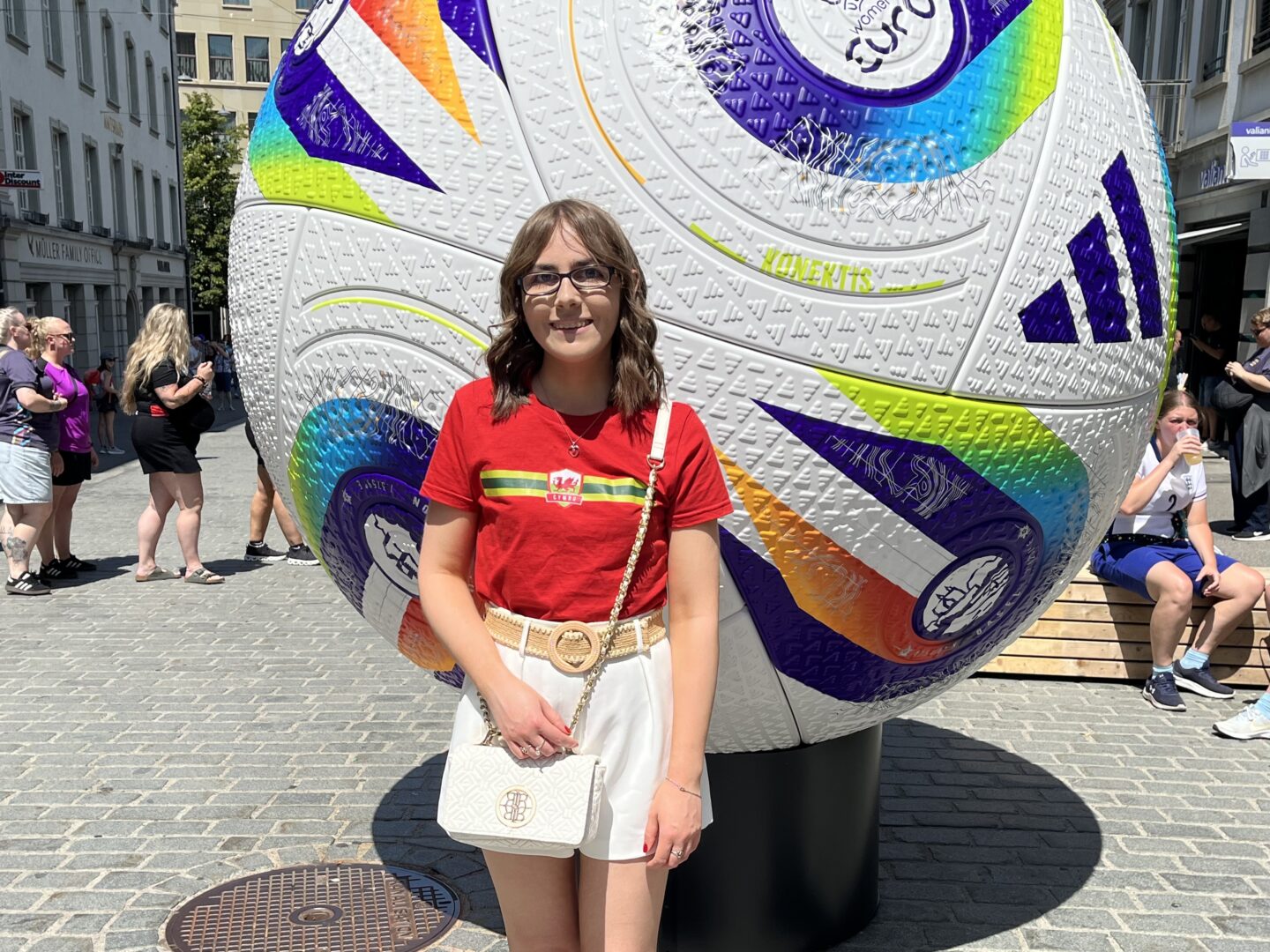
In the city
Our bank accounts were grateful for the free matchday travel as we made our way via one bus and two trains from our ghost-town-like base in Waldkirch to St Gallen. My inclusion-chasing heart was satiated by the level access trains, which swept us into a city vibrant with colour, song, and the quiet thrill of a Wales v England clash.
Opposing fans competed to be heard in song as we wandered down the street dividing the pubs that had become home to each side’s faithful.
After seeing what a sun-baked St Gallen had to offer, people watching, or listening, became an event in itself. Chants, songs, and laughter wove together into a tapestry of Cymru, suffusing me with pride as I sat there, soaking in the atmosphere.
It was special, but just the beginning. A delicious gluten free pizza fuelled us for the night ahead, and as kick-off inched closer, we made our way from the city-centre towards the stadium. A packed, claustrophobic bus deposited us onto a street where we joined a river of red in a fan walk that felt like a travelling carnival.

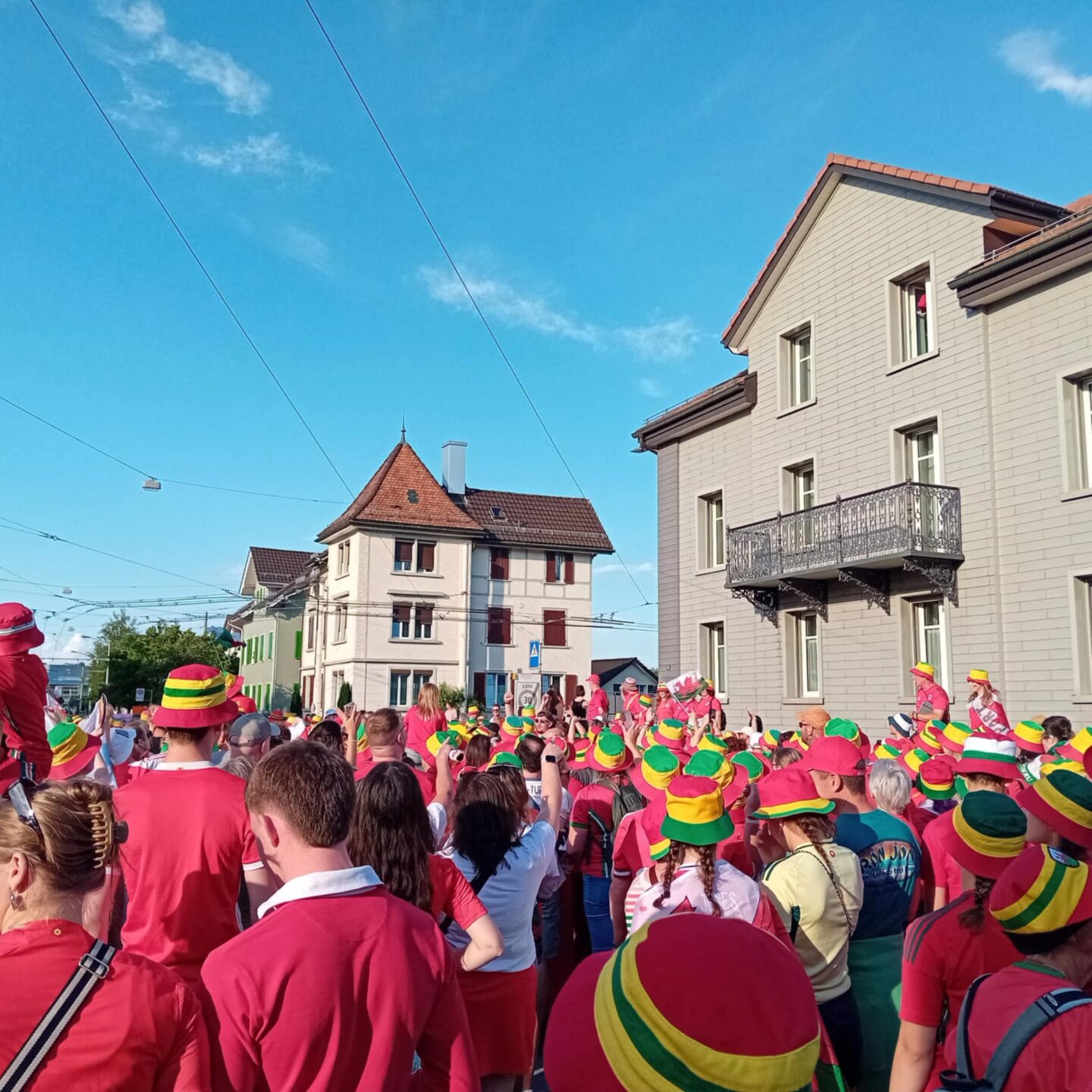
‘Hen Wlad Fy Nhadau’ rang out with reverence, and ‘Yma o Hyd’ was just as stirring, an anthem reborn, defiant and full of soul.
There was something electrifying about hearing Welsh voices ricocheting off stone facades, filling the air with song, laughter, and that familiar, contagious hope that only football can summon. Bucket hats bobbed through the crowd as we moved through historic streets, my own a part of the movement.
Whilst a few white shirts of England fans pierced the sea of red, our friend included—I know, how dare we mix with the enemy? St. Gallen almost felt like a corner of Cymru, buoyed by the presence of fans who had traveled from every corner of our land, each of us swept up in something far bigger than ourselves.
I’ve attended many football matches, but nothing compares to the feeling the fan walk evoked as we journeyed toward the stadium. It was special, joyful, and unforgettable.
Accessibility
No trip of mine can be made without a close inspection of the accessibility information – it’s second nature to assess how included I’ll feel in any given situation. So I was impressed to find UEFA’s dedicated accessibility section for the Euros on their website, which included details about matchday travel, sensory bags at the stadium, accessible concession stands, and, to my delight, audio descriptive commentary.
My first taste of AD commentary came at a Nations League game between Wales and Sweden back in February. It transformed the entire matchday experience, helping me feel fully immersed and included in something that had always felt just a little out of reach through regular commentary. The idea of revisiting that experience at the Euros was a thrilling prospect.
The catch? AD commentary was only available in German, with French added in a couple of stadiums. I’m sure you can imagine my disappointment, especially when the men’s Euros offered commentary in multiple languages just a year ago.
It’s promising to see access being prioritised at such a major event, but organisers must remember that true accessibility means being fully inclusive. You can’t have one without the other. There needs to be provisions in place to ensure every fan can engage without barriers.
Plan B for me was radio commentary. Safe, familiar, easy to access, as long as my mobile data and signal played ball.

The successful test-run I completed before kick-off left me feeling quietly smug with my backup plan. But when the whistle blew, the sound in my earphones didn’t mirror the crowd’s roar. The delay was painful from the get-go, a full half-minute gap between what was happening on the pitch and what I was hearing in my ears.
The crowd’s cheers swelled in one ear, while the quiet commentary came in on the other, completely out of sync with the pulse of the match.
The delay meant I’d hear about an England goal long after we’d already lived through the pain. Hearing it once was bad enough, especially since we were surrounded by England fans…
I persisted with it for a while, but there came a point where it felt like emotional masochism, so I switched off the commentary and let the atmosphere do the storytelling.

The match
A hush descended on the stadium as the Red Wall prepared to sing their hearts out for the national anthem. And while we were two red smudges in a sea of white, slightly isolated from the chorus of voices to our right, there was something magical about the moment. There’s truly no greater feeling than hearing your country’s anthem on the big stage.
That magic did waver, though, as an early controversial decision saw England’s Georgia Stanway convert a penalty into the team’s first goal.
From then on, the Lionesses were unstoppable. The delayed commentary told me of their seamless passing and undeniable fervour which proved to be too much for Wales to handle as Manchester United’s Ella Toone doubled the defending champions’ lead.
There were missed chances for both sides: Keira Walsh and Alessia Russo were both unsuccessful in their efforts, whilst Wales captain, Angharad James, forced Hannah Hampton to make a save, before Jess Fishlock fired a shot wide.
The momentum was all England’s, though, as goals from Lauren Hemp and Russo saw the Lionesses cruising towards half-time with a four goal lead.

‘She’ll be next on the scoresheet,’ I stated as Beth Mead came on as a substitute for England in the second half, and sure enough, she struck to make it 5-0. If only I’d known I had such powers, I might have predicted Wales would have the upper hand instead…
There wasn’t a Wales fan who was naive enough to think that this was a game to be saved, but a lone goal from Hannah Cain, created from an all-mighty Fishlock pass, gave us a momentary reason to celebrate.
Having been drawn into arguably the toughest group of the tournament, Wales supporters knew it would be moments like these we’d savour as we went head-to-head with such seasoned sides. Cain’s strike, fittingly taken and celebrated in front of the Red Wall, and Jess Fishlock’s finish against France, will both go down in history as the team’s first imprint on a major stage. From here, the only way is up, and hopefully the future will take root in these quiet triumphs.
England had the final word, as Chelsea striker Aggie Beever-Jones etched her name onto the scoresheet with her first major tournament goal, making it 6–1. Though we’d left early to beat the crowds and missed the moment, England’s cheer still echoed beyond the stadium walls. While the scoreboard belonged to the opposition, Wales fans, unwavering in their support, wove their voices into the soundtrack of the occasion, carrying on long after the final whistle.
And that’s what I’ll remember most. Not the scoreline, but the sound of thousands of voices refusing to be quieted, cheering on a team who has performed with pride.
It wasn’t the easiest match to follow without any form of commentary, and I missed more than I’d like to admit or accept on this level, but what I didn’t miss was the sound: thousands of voices lifting Wales into history. Being part of that chorus mattered. And if this is what the beginning looks, and sounds, like, then I can’t wait for what comes next. Here’s hoping it’s just as loud, just as proud, and a little easier to follow.
Have you been watching the Euros at home, or have you made the trip to Switzerland yourself? I’d love to hear your take on the accessibility of the competition if you’re a disabled fan — or perhaps you have some success stories away from the tournament? Accessibility and inclusion make the beautiful game even more beautiful for all of us, and we need them to be a priority to ensure nobody is left guessing at the biggest moments.
Share this:

Discover more from My Blurred World
Subscribe to get the latest posts sent to your email.
You May Also Like


The Comments
Holly
This sounds like the most amazing experience, and I’m so glad you got to go to the iconic, history-making Euros! It’s such a shame about the AD, especially when it was available for the men’s tournament last year. That speaks volumes.
Loved reading about your experience of the match xxx
Elin
HollyThank you lovely. We definitely need to see more AD in the women’s game xxx