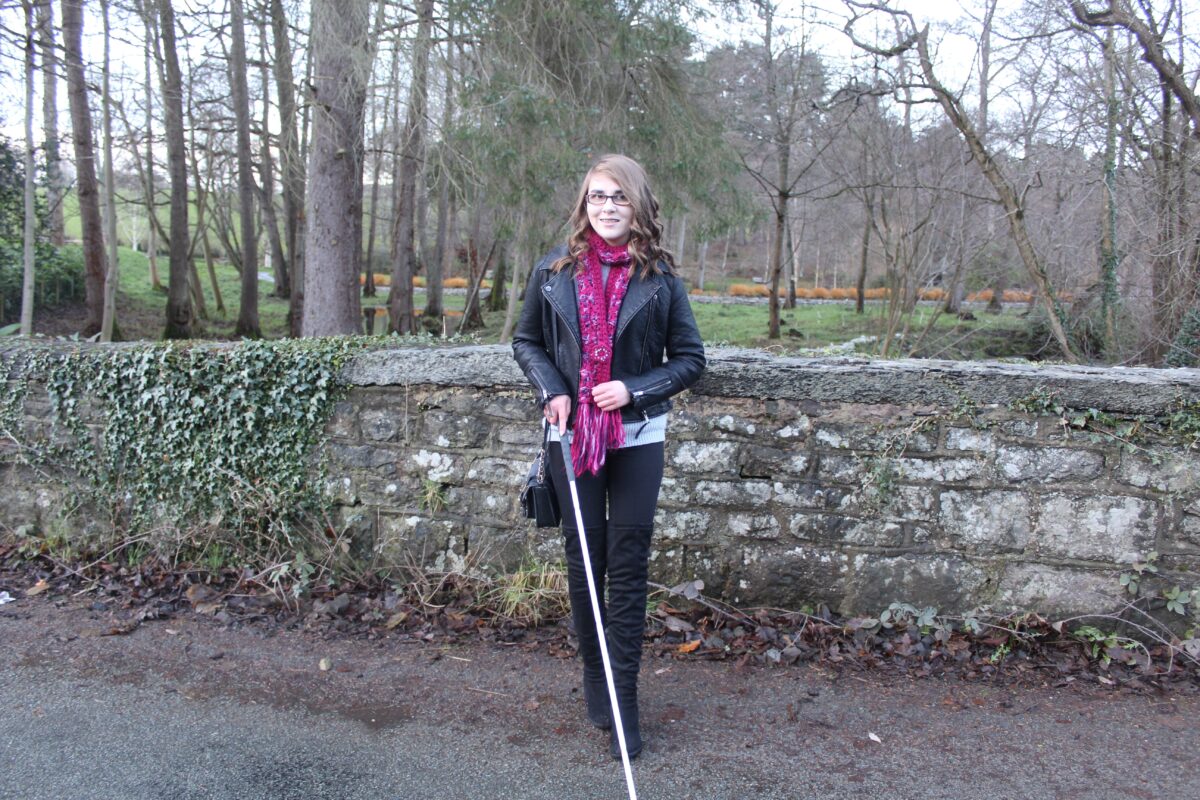
Let’s talk about the cane.
My experience with the white cane is something I’ve wanted to explore on here for a while but it always slipped to the back of the queue since I didn’t know how to explain my feelings towards it.
But that’s all changing today as the RNIB have kindly asked me to take part in their latest campaign, presenting the perfect opportunity for me to delve into my experience using the long cane, and talk about the debate the campaign focuses on.

RNIB’s #HowISee campaign has been running for quite some time now and I’ve written two posts in response to it, you can read my latest one here. They recently launched this video, talking all about whether or not the traditional white cane should be personalised or if it’s better for it to remain its traditional colour. In today’s post I’m hoping I can share my views on this debate but before that, I want to share my experience of using the cane with you as I’ve never talked about it in much detail on my blog before.
My experience
Let’s go back to the beginning, shall we?
I started to receive mobility training with a cane when I was 8 years old and, as you can imagine, learning to use this mobility aid at such a young age was quite daunting. I was still coming to terms with my diagnosis at the time and trying my upmost to understand it, this was hard enough in itself and being introduced to the cane magnified this uncertainty in a way because I didn’t like the thought of being different. I was being bullied at the time and didn’t want to add even more fuel to the fire, as it were.
As I was so young when I started the training, I wasn’t particularly aware of the benefits of the cane, what it was, how it would allow other people to realise that I had a vision impairment and therefore needing that mobility aid to navigate my surroundings. But, I was unconfident, insecure and afraid, and that’s why I put my cane to one side and didn’t pick it up again for eight years (until I was 16).
There would be the occasional time during that period where curiosity got the better of me, I remember tentatively unfolding the cane and chancing having a go around the house to see how it would benefit me, but I never took it outside. Small steps though, my friends, small steps.
There were a number of times when my Qualified teacher of vision impairment (QTVI) and my mobility instructor tried to prompt me to use the cane around school, they claimed that it would help students to realise that I had a vision impairment and that it would help me in some way. Me being my stubbon self though, I didn’t see it that way.
Looking back now, I note my logic in that refusal. Living with a deteriorating eye condition meant that there were, and still are, a lot of aspects and emotions to adjust to. Through casting the cane aside, I was making space to address those feelings and trying to pinpoint the most positive way of going about my day-to-day life. I could have done so whilst adding the cane into the equation, of course, it’s absolutely possible, but I needed that time to come to terms with all those altering elements of my vision impairment before I took such a step.

During my first year of sixth form, hearing the whispers of excitement exchanged between students about learning to drive, and later passing their tests, sparked this personal urge to promote my own level of independence. I was introduced to a new mobility officer who gave me the motivation I needed to pick my cane back up and look at it in a positive way rather than in a negative one. We seemed to be on the same wave length and I felt more at ease with her than I did with my previous mobility officer. She managed to pick at the unravelled strands of my confidence and helped to weave them back into place, and I soon learned to embrace my cane rather than letting it define me. That was one small step for me, one giant step for… No, maybe not.
Although I was still adamant not to use it at school, I started going out and about with my cane and started to learn the techniques of using it again.
We started by going to quiet spots in my local area and then, as my confidence grew, we ventured into the busy towns. Not having that feeling of dread and anxiety to use my cane in public was such a relief for me and I’m so grateful that someone was able to give me that confidence I needed when using it.
Since starting to make use of my cane again in 2015, my confidence has steadily graduated. I can’t deny that I still get the occasional flutter of anxiety and self-consciousness when I’m out and about, but that is very rare compared to what it used to be. If I go out independently then I’ll use my cane to navigate my surroundings and feel no shame in doing that. No one should feel ashamed to use a mobility aid, I’ve definitely learned that over the past couple of years. If it helps you in some way then why not embrace it rather than feeling ashamed or embarrassed by it?
Of course, not everyone is going to be accepting or understanding of the cane, what it means for us blind/VI people and how it helps us. I’ve been told that I get the odd funny look when I go out and about but I can’t see those people staring anyway so why should I be phased by it? If my cane allows me to gain independence, those looks and judgements leave no bruise.
The cane debate
There is a lot of controversy within the blind/VI community at the moment. People are debating whether we should use the traditional white cane or if it’s acceptable to use a coloured one.
Although I’ve had my moments of feeling self-conscious when using my cane, I’ve never felt ashamed or conscious of it because of its colour. I wasn’t aware that it was possible to customise a cane until a year or so ago so that’s why I’ve always been a user of the traditional white one.
I think that the cane is not only a mobility aid for those of us who are blind/VI but it’s also an indicator to members of the public that we have a vision impairment and that they need to be aware of that. I don’t think that many people are educated on what the cane is and what it means but those who are will typically assume a blind/VI person to have a white cane as it’s recognised universally. Having/using a coloured cane might lead to some confusion amongst the public but this doesn’t mean that a coloured cane shouldn’t be used. At the end of the day, if the coloured cane is seen more often, people will become aware of it and therefore will eventually be educated on its purpose.
I think it’s a nice touch when we are able to customise our mobility aids. It allows us to make it more personal to us and feel more confident when using it. I’ve heard that many people prefer using a coloured cane because it’s more of a reflection of their personality and it allows them to put their own stamp on their impairment and the mobility aid(s) they use.

Using a coloured cane does come with its pros and cons but then again so does a white cane. As I said before, people might be more aware of the white cane and what it’s used for and might be confused by the concept of a coloured cane, but on the other hand, using a coloured cane can spark conversations, it can intrigue people and encourage them to communicate with you which might not happen when using the traditional cane.
In my opinion, it’s all down to personal preference at the end of the day. We shouldn’t be told which cane to use, we should use the one that we feel comfortable and confident in using, the one we don’t feel ashamed or embarrassed to use when out and about.
I’ve never had or used a coloured or personalised cane so I can’t comment on whether or not I prefer them to the traditional cane. Although, looking into the coloured cane is on the cards for the new year, for now, I have no problem with using my white cane and I can only hope that my confidence continues to grow when using it.
Personally, I don’t see myself ever choosing to use a coloured cane over my traditional white one but there’s no particular reason for that, it’s just what I’m used to. I’ve already mentioned that I’m going to look into getting a coloured/personalised cane because I’m interested to know how I’ll feel about it. Who knows, my views might completely change.
I don’t think there should be a right or wrong answer to this debate, it all comes down to personal preference. Some people might want to stick with the traditional cane because they feel safer that way but others might want to express their individuality and put their own stamp on their cane and I don’t think there’s anything wrong with that.
You do you.
Are you blind/vision impaired? If so, what are your thoughts on this debate? Be sure to let me know as I would love to hear from you.
Don’t forget to add your voice to this conversation by using #HowISee. Thank you again to the RNIB for asking me to get involved.
I’ve definitely had a love/hate relationship with my cane and that’s still true on some days but, most often than not, I’m not ashamed of using my cane anymore and that’s something I’m really proud to be able to say.
Elin x
Share this:

Discover more from My Blurred World
Subscribe to get the latest posts sent to your email.
You May Also Like




The Comments
Lynne Nicholson UK
Hi Elin
Whenever I read of people being embarrassed or otherwise negatively impacted by their white cane I kind of want to shake them until their teeth rattled and I wondered if it’s an age thing as when I learnt I was losing my sight and realised the prescription specs I wore to gain a few inches more vision were emphasising the distortion that was causing dizziness and nausea and headaches and when I stopped wearing them I no longer had balance issues except in crowds all I wanted was a white cane to replace my white walking stick. I’m now 56 and was diagnosed just over 14 months ago it took 9 months from diagnosis to first visit from a ROVI and I wasn’t interested in lighting, magnification, home aids as I’d sussed out what worked for me but the white cane training so I could regain my independence and find obstacles before I fell over them (therefore needing to save myself from falling by still using my walking stick even though I was no longer constantly dizzy).
Wanda Power came into my life and she truly is my wand of power magically restoring my confidence and allowing me to start walking for pleasure again not just to get to the shops or other essential destination. She is helping me explore my new neighbourhood ( I moved 5 weeks ago).
As for colour of our canes personally for me I crave while I can still see them bright colours however if/when I bling Wanda it would only be the section below her handle as currently seeing the white against the darker pavement, Road, verges, and woodland paths is more important to me as it gives me an idea of my relative position as I have visual disturbances some of which are physical and some are caused by Charles Bonnet Syndrome so the white “grounds” me. However if others want their canes to match their personalities or outfits or whatever why not. Can you imagine the reaction if we told people they can only wear flat black shoes or carry a certain colour or style of bag? Yes it would mean educating people but whatever colour the cane it is still used in a similar way and is obvious whether a guide cane or long cane in use. The symbol cane may be the only one not obvious but I didn’t know they existed until my ROVI told me that in her opinion I wasn’t suitable for one and didn’t yet need a long cane but a guide cane was ideal… unfortunately I didn’t get trained in all the areas she said I needed training (supermarket, escalators) and come the autumn leaves beginning to fall I found the method she taught was no good so I got a ball tip from the rnib and started using it and suddenly was more confident and found it to be safer. Just because I’m a fast walker I plan on buying a longer cane and will be buying long canes rather than another guide cane as the handle is better designed and I expect to have less cramping in my hand.
Here’s to canes the wands of power that give us back our lives whatever colour or style we choose for ourselves
myblurredworld@gmail.com
Lynne Nicholson UKHi Lynne,
Thank you for your comment and for taking the time to read my post. I think it definitely is an age thing when it comes to feeling embarrassed of the cane, as I’ve grown older I’ve learnt that there’s no need to feel embarrassed or ashamed of using it and I feel proud that i’m able to use it now because as you said it allows us to gain independence. I’m really glad that your cane has given you confidence and independence and I definitely agree with everything you said. We use our canes in the same way no matter what colour they are so if someone wants to have a coloured cane then I think they should by all means go for it. Thank you for reading.
Holly
It’s such a great campaign. I know how hard it can be to feel comfortable when using a cane, I was exactly the same as you know so can relate to your experiences. Well done you for sharing your experiences my lovely! You’ve come so far and should be so proud! xxx
myblurredworld@gmail.com
HollyIt definitely is! Love hearing everyone’s views on it. Thank you so much my lovely, that means a lot xxx
Tony
Be loud and be proud I say.
I am fully sighted but I do wear hearing aids. I don’t try to hide my disability because I have found that It helps other people to understand that I’m not ignoring them when I do not hear them clearly or respond to them immediately.
I believe that if someone wants to use a light sabre for a cane that’s their individual choice and should be embraced as an expression of their individuality.
Thanks for sharing your own experience with us.
myblurredworld@gmail.com
TonyI completely agree! It’s definitely all about expressing who you are and being proud and embracing your disability rather than feeling any other way about it. Thank you for reading.
Aya
Hello,
I used to think like you when I was in school but not about the cane but my glasses.
I have a rare disease so doctors only told my parents I will be blind later but none of them told me I was VI and none of them helped me to go through of it.
In a way, I’m grateful to them cause I was able to have a “rather normal” childhood. But in a same time I’m badly angry with them cause my struggles could have been really different and I could have had some help.
So I felt like I was not normal because of my glasses and I refused to wore it outside even now… It’s really hard to forget about “what people can say/think of me”.
Now about the cane, I don’t know if I could use it. If I could stand “the others”. But if I was to do, I would be really happy to customise it. It will be my touch of fun, my touch of color and I think I would be really happy to have something I find cute and nice and useful. I don’t really know how to explain it in English, sorry.
myblurredworld@gmail.com
AyaI can understand how you’d feel angry towards them for not telling you you’re VI, I’d be the same. There’s no shame in being VI though and using the things that come along with it. I think that glasses can be something quite fashionable these days, so many more people seem to wear them so it’s something really common and nothing to be ashamed of. I totally get where you’re coming from with your cane. It can feel daunting to use it but I think it’s important to remember that people’s opinions don’t matter if it’s something that helps you. If you can make it your own and feel confident using it because of that then go for it! Thank you for reading 🙂
Heidi
Thank you for sharing your story. It just goes to show you that we all need to share our stories because they are inspirational and educational. I had no idea there was such a debate, but I am so happy I do now. I’m informed now and that’s not something I would’ve learned in a textbook. So thank you and looking forward to reading more. Happy New Year 😀
myblurredworld@gmail.com
HeidiThank you so much for your lovely comment, it means a lot. Happy new year to you too! 🙂
Emma
Hi! I’ve just found your blog a month ago. Ilike it so much. Many of your struggles have veen like mines or similars. I’m 36 now… last 2 years my vision has been decreasing much more because of rp. I stopped driving, i’ve been struggling last 6 months beacuse i’ve started to embrace my VI and ao my husband an my kid.
I’ve been wondering if a cane will bring to me a relief in a way that people realize my vision is not fine without telling’em; but by watching the cane.
I think its harder to be in the middle (looking normal, having good central vision but people wanting me to behave in certain ways i just can’t because of thelacknof peripheral vision) than showing the cane.
I’m not using it but this article makes me reconsider my options for being independent.
Thanks a lot. Nice to meet you, Elin.
myblurredworld@gmail.com
EmmaThank you so much for taking the time to read my blog, it really means a lot and I’m glad you enjoy it. I think it’s all down to personal preference when using the cane. I used to feel like it made me ‘different’ and I still do in some situations but personally, it gives me so much more confidence when going out independently. Let me know how you get on if you do decide to start using it. I hope you’ve had a great start to your week 🙂
Jennifer
EmmaHi Emma, I also just found this blog (love it!) and wanted to respond to your post. There is a type of white cane called a “signal cane”. (This is in the US. I don’t know if it is called something different in the UK or where you are.) Just a thought if you decide that you would like one to carry to try to show people that you have vision loss. It is shorter and lighter than a traditional long cane and can also come with a folding option. It is also flimsier, so it is not recommended that you use a signal cane for everyday use! I am sighted but my friend has Stargart’s and she only uses her cane, which is a signal cane, at the airport. She cannot read any of the information signs so needs to ask people about things that might be right in front of her (gets rude comments otherwise) and it gets her to the front of the line as a bonus.
If you are in the US, you might try searching for “United Blind [your city]”. There are a large number of social groups with that name. I hope you have a wonderful journey of independence and acceptance even though there are bumps in the road.
PS. Elin, love the blog. I am studying to be a Teacher of the Visually Impaired (TVI, the US version of your teacher) and orientation and mobility instructor. My biggest passions are braille and accessible science and math activities.
myblurredworld@gmail.com
JenniferThank you for your comment Jennifer, I believe that particular cane is called the ‘symbol cane’ in the UK so very similar! And I’ve heard that many people prefer using it to the traditional cane so it’s definitely worth looking into. Ahh it’s so great that you’re studying to be a TVI, I hope it’s all going well so far. Thanks again for your comment and I’m really glad that you like my blog, I hope you enjoy my future posts. Have a lovely day 🙂
Neil
Thank you, Elin, that was an interesting read!
Although you wrote this over a year ago, I had no idea there was a debate in progress about coloured canes. My cane is plain white, as I feel that it’s easier to stick with something that will be as universally recognised as possible, especially when abroad. I do need to stop procrastinating and get a British one with red sections on it for my hearing loss, though!
On the subject of customisation, I used to work in Germany, and I met people who kept their canes white, but had them customised with tactile motifs. There was actually a gentleman who offered the service as part of his own small business. I particularly remember one lady whose cane had interlocking diamonds and dot patterns that were fascinating to touch (she kindly gave me permission). Very nifty.